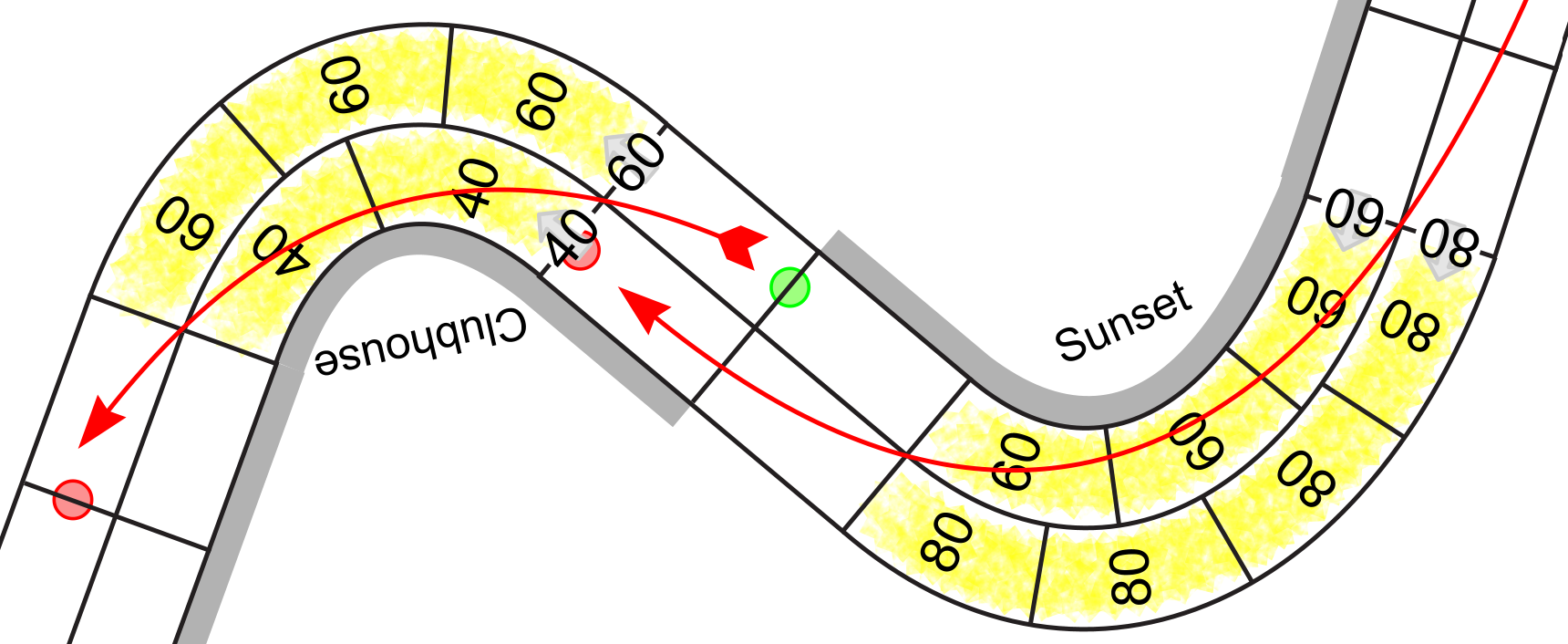
Wednesday, November 12, 2025

CFR Organized Play 2025 Season


Don Tatum
won Redscape's second tier.  Then completed a comeback to win P1 after trailing Tim Mossman after 2 races.  Combined that gave Don enough points (97.75) to overcome Tim Baker (80.25 pts).  Rando rounds out the top three this season with 77.88 points.

The four top events on the calendar were won by four different drivers this year.  So the championship came down to their next best finish and Don was the only driver to win a top tier event and a 2nd tier event.

Don becomes the first driver to win three CFR OP Titles -- having won in 2018 and 2019.  Don also extends his record streak of 9 straight top 10 finishes in the OP rankings.  Michael Polcen's streak ended this season at 7 in a row.

Sunday, November 17, 2024

Pretty Certain CFR Rule Changes

As some of you probably know, I've been tinkering and testing some changes for the next edition of Championship Formula Racing.

I'm pretty sure this is where it will land.  Specifically, I'm pretty sure about the forced passing bits.  I'm 100% certain about the other bits.

So here they are.

Tests


In an effort to simplify down to two basic tables, Start Speed now has the same odds as testing any other attribute.  A start speed failure results in a mis-shift and the loss of one wear.  Start Speed is never damaged.  I like removing the stall possibility.  Losing your turn on the start when you were trying to go 120 is bad and I think the loss of a wear and a mis-shift is penalizing enough.

I also added a mis-shift to the failure result for Top Speed and Acceleration.  I found it confusing that you would test top speed, fail and end up going faster this turn than your new, damaged top speed.  I think having a mis-shift when you fail an Acceleration or Top Speed is more logically consistent.  I think it also makes the rolls more impactful, especially at the end of the race.  It is no longer a no-brainer to test your engine as you cross the finish line.

No change to testing deceleration.  I just included the table here for completeness.

Forced Passing


This process underwent the most change.  I wanted to end up with a single table for Forced Passing. I wanted to make it a little easier for the attacker, but not too easy.  I wanted to change the interaction between the attacker and the defender.

The first change was to how "blocking" works.  Instead of the defender just declaring that they are blocking to add 2 to the attacker's die-roll, the defender now has an opportunity to spend their own skill to add to the attacker's die-roll.  Spun defenders may not.  The attacker will still have an opportunity to add their own skill after learning what the defender is doing.

The odds obviously changed as well.  On the one-hand success now occurs on any result 9 or less.  But, a success of 7 - 9 also includes a wear damage to the attacker and the attacker must now roll on the Avoid Damage table.  This could result in another wear lost and possibly a wear lost for the defender.  The attacker may apply skill to this roll as well.  The defender may not.  If the defender is called on to lose wear, it does not matter if the defender used skill to hamper the attacker ("block") or not.

In the end, Forced Passing is easier to accomplish but will likely be more costly.  

Avoid Damage

This table replaces the old Avoid Crash table but is now used both to avoid a crash as well as to avoid additional damage after a successful forced pass with contact.  

On a 10-12, the result differs based on those two situations.  If this roll resulted from avoiding a crash, the driver loses 2 wear.  If this roll came after a forced pass then the attacker loses a second wear (since the attacker lost 1 on the forced passing table) and the defender loses a wear as well.


Slips at End

There is a game that can happen in the current rules -- If two cars are lined up with the finish line in sight and both cars can go 180.  It's a dumb game.  So, If you will finish the race this turn you may not take more than 1 slip.


Zero-base Car Builds

This isn't a rule change, but I am going to rejigger the car set-up table so that there are no longer any -1 values.  All of the math will remain the same, but all of the number will be positive.


Thursday, October 10, 2024

2024 Organized Play Crowns Another Back-to-Back Champ

 Congrats to Jason Schultz.  He was in the driver's seat with only the WBC really in play and he took care of business.  Winning WBC took Jason from probably the champ to running away with it.

Jason is now the 3rd consecutive, back-to-back champion in organized play.  Fellow, back-to-backers Don Tatum and Stephen  Peeples finished 2nd and 3rd this year.  And fellow champ Michael Polcen finished 4th.


Jason and Don were the only drivers to win multiple tournaments this season.  The big difference in their scores is that Jason won two of the biggest events while one of Don's wins was a smaller event.

Thanks to all who raced this year in a OP event (111 of you) and I hope to see you all for the 2025 season -- which is already underway.

Wednesday, June 5, 2024

2024 Organized Play Update

 I've finally done some data entry for this season of Organized Play... here are the top 10 with ~2 events to go.  (Full list here.)


The top 3 is a murders row of the winners of the past 5 OP titles.  Don leads currently but he should not feel very comfortable with that lead.

The two remaining events to score are my PBeM serieses and the WBC tournament.  Both are worth big points and Jason has a commanding lead in the top tier of the PBeM.  If he does win that series it will be worth nearly 57 points and would give him just over 91 on the season.  

If we assume Jason wins P1, there will probably still be an opportunity for the top 7 drivers on this list to make up enough points at WBC to end up at the top of the heap.  Assuming a similar turn-out at WBC to last year, the top spot will be worth almost 60 points.  

Of course, WBC will be over before my PBeM so there is also the potential for someone to win WBC and do just enough in their PBeM race to pip Jason (or Don).  Keep an eye on people who could get second in the P1 PBeM series (Jeff Harrington, Gianluca Lari, maybe Tim Mossman, theoretically a couple others) and people who could win or place 2nd in the Divoll and Reilly tier... (Robert Rund, Michael Polcen, Palmiro Matteini, Brent Fitz, and others).  If they win WBC they might have a shot at the title too.


Thursday, August 31, 2023

Final 2023 Organized Play Ranking

 The 7th CFR Organized Play season is over and despite a new ranking system I think the champion is pretty obvious.  Jason Schultz was the only driver to win more than one event this year.  Jason actually won 3 of the 4 events entered.

Jason's big win was the Ikea Cup event -- a large Table Top Simulator tournament.  But four other drivers won comparable events.  The kicker was winning Divoll -- a tier 2 event in my PBeM series.  This was by far the best 2nd event result by any driver.


Rookie of the Year

C Moratto gets the nod here after placing 4th in Redscape C4 in his first ever Organized Play outing.

Most Improved

Will McConchie made a big jump in his 2nd season in Organized Play.  Capping it off by winning the tier-4 Clark series.  This pushed his ranking to 27th, up 87 spots from last year.

Honorable mention to Tim Baker who jumped 42 spots up to 3rd in the rankings.  The biggest increase among drivers who finished in the top 20 this season.

Steward of the Year

Since I'm only really paying attention to events now, I'm going to hand this to Mr. Polcen.  Michael officially is in charge of two different series of events... the 4-race Redscape Ladder PLUS the Table Top Simulator hosted Ikea Cup event.  And I know Michael would acknowledge that he is mostly a proxy for the wonderful stewards that run various races in those series.  

Thanks to all stewards.

Monday, July 24, 2023

New OP Ranking Method

Some of you may know that I've been struggling this season to get caught up with CFR Organized Play rankings.  The two culprits I have identified is that I have been busy and past me constructed a pretty elaborate system for calculating OP rankings.

So I'm simplifying.  A lot.

I used to track every result from every race and calculate a whole series of things to try to judge relative competition.  Now I'm just going to track the results of events and I'm going to use a simpler method to judge competition levels between different events -- more or less just counting the number of participants.  More here.

This makes my work much more manageable.  And so an in-progress 2023 season rankings is here.

Monday, March 27, 2023

WBC 2023 Tracks


I expect someone to get angry here in the finals.

WBC steward Chris Long has picked some tracks for this year's WBC event.

A nice mix of tracks below.  The first group are some real classics -- three of the most raced tracks in F1 history.  Group 2 is a collection of fan favorite modern era tracks.  Then the last grouping includes 2 tracks never used in WBC qualifying before -- Kent which is a new design and Indy which made it's WBC debut as last year's finals track.  

This year's finals is another brand new to WBC track -- Midrand, also known as Kyalami.  

Good luck all.

Q1 Red

Q2 Purple

Q3 Green

Finals

Monday, October 17, 2022

CFR 2022 Organized Play Concludes (Finally)


In the end, only 4 points separated the top two drivers this season.  With last year's champion Stephen Peeples just edging out former two-time champ Don Tatum.

The rest of the top 10 was a mix of regulars and break-throughs.  Michael Polcen runs his streak of top 10 finishes to 5 seasons (1 short of Don's 6 seasons).  Chris Long and Tim Mossman have had multiple top 10 seasons before but Tim was 40th last year and Chris hasn't been top 10 since he finished 3rd in 2018.  James Benham made his first top 10 last year.

Jason Schultz ended the season 20 points behind our champion but in only his second season of organized play.  Will Kennington, Justin Swaine,  and Brent Fitz also made their first appearances in the top 10 this year.

But lets dig into how Stephen beat out Don this year.  Below is a break-out of how each of them got points this year -- their top 5 race results and their top 2 tournament results.  And some general data as well.


That general data tells an interesting story.  Stephen beat Don despite Don winning more races (and even a higher percentage of races) and more tournaments.  But you can also see the first clue here of how Stephen overcame that -- tougher competition.  By design a field rating of 1 should be average (the median race field rating was 0.97 this year).  So we can see that Stephen's average race was considered above average in difficulty of competition while Don's was -- on average -- considered below average.

This doesn't mean that Don was racing against shlubs.  What it really means is that most of Don's wins came against smaller groups of opponents and/or not the very best of competition  Below are the top 11 races, ranked by field rating this year.  


As you can see, Stephen won 4 of those races.  Don won 2.  Stephen also had a second place in one of these races.  In fact, those are the five results that add into Stephen's score for the year.  Because the points you get for results in a race are multiplied by the field rating of that race, you can see how Stephen ended up with more points than Don.

To find Don's other wins, we scroll down that list a little.


Don's 3rd best win was against decent competition but not the very best.  A bit further down the table, Don's 4th and 5th (... and 6th) wins were against smaller fields.  Anything less than 8 people is considered a smaller field and will tend to have smaller field ratings.


That last bit is based on my most recent adjustment to the scoring (see this post for some detail on that change).  And yes, this change was made mid-season as I saw more than the usual number of smaller fields seem to really skew results.  I acknowledge that this might be controversial.  But I will have more to say about that in a future post.

For now, lets congratulate Stephen on his #1 ranking and Don for another outstanding season.

The Regulars

Don Tatum participated in what I am going to assume is a record 35 races this season (and season high 6 different tournaments).  That comes out to 40% of the number of races Don could possibly have participated in (and almost 40% of the tournaments).  Will Kennard participated in 28 races and Kevin Keller in 25.

Rookie of the Year

Rookies did not show prominently in the rankings this season.  But Chris Manning gets the nod by ranking 68th in his first season, powered by a 2nd place finish in one of the the two races he participated in.  Andrew Koerber was  close runner up at 70th.

Most Improved

Doug Galullo had a down year in 2021.  Having been ranked as high as 2nd in 2018, he fell to 97th last year.  But bounced back this year to 17th.  Much more his usual territory.  Honorable mention to Jason Schultz Who won 6 races this year and jumped from 73rd ranked last season to 3rd this season.

Steward of the Year

This is probably my favorite award.  Stewards make CFR happen.  Especially organized play.  I try to find new people to highlight every year but in a first... (I think) a repeat for Brian DeWitt.  Brian not only has people nominate him every year... he ran a very impressive 12 races this year.  Often as double-headers.

Other Numbers

This season saw a record number of races in organized play at 87 -- 4 more than 2020.  And a larger increase in the number of racing opportunities at 53 -- up from 45 in 2019.  Many tournaments are set up such that you can't race in every race because there are effectively or literally multiple races going on at the same time, the number of racing opportunities is always a bit lower than the total number of races.  The total number of drivers participating in organized play was up from last year to 122 from 104.  But 122 is still down from the 219 high of 151.  Field size shrunk this year from 9.4 to 8.3.  Field size has generally been shrinking over the last 10 years or so.  Although it had held pretty stead around 9.5 drivers per race from 2017 through last year.

Monday, June 20, 2022

2022 Organized Play Update and a Ranking Tweak


We are well into the 2022 CFR Organized Play season and I've updated the rankings.  Finally.  Thank you for your patience.

Note that these rankings do not account for the 2nd races from my series.  Updates from those races will occur when all results are in.

A note on the aforementioned ranking tweak.  I noticed as I was entering race results that we had a larger then usual number of low player-count races -- 4, 5, 6.  These results seemed to be skewing the rankings so I made a tweak to how I adjust race scores based on the field.  I used to simply use the average ELO of the top 10 drivers in the race.  This was designed specifically to not penalize people for smaller races.

Now, I'm taking the top 8 driver ELOs and dividing by 8.  So if there are fewer than 8 drivers in the race, it will not be worth as many points.  I am happy with this fix but there is another big consequence.  This spread out the value of wins a lot more than in previous seasons.  Most wins were pretty close in value, maybe with a difference of 2-5 points.  Now there is enough spread that there is some overlap in the total points for "bad" wins and "good" 2nd places.

I'm doing the same thing with tournament points now as well.  For tournaments I used to be looking at the average of the top 20 drivers.  Now I'm taking the top 8 divided by 8.  I haven't yet seen any 4 driver tournaments but this does mean that the top heavy tournaments will be worth more.  Which I think makes sense since only the top 3 drivers can get tournament points.  So the 18th best driver in that series is not too important.

Back to this year's rankings.  One result of the bigger point spread for wins is that there is still plenty of opportunity for the top drivers to improve their scores as the season closes out.  A high quality win could be worth 10 points or more to any of the top drivers and the top 4 drivers are all currently within 8 points.

So I'm going to be keeping a close eye on the top series in my PBeM.  Stephen P, Chris L, Don T, Michael P, and James B are all in that series and a race win there is a big win.  Stephen and James are also neck and neck for the series win.  That should set everything up nicely for the last tournament of the season at WBC 2022.

Tuesday, June 14, 2022

WBC 2022... It's On!


Indianapolis corner 1 at the end of a 4-wide straight.
Two years ago WBC steward Chris picked tracks for the WBC CFR tournament.  Now you all will finally get to race those tracks at WBC 2022.

Instead of repeating myself... here's the list of tracks.

Good luck all.

Wednesday, November 3, 2021

CFR 2021 Organized Play Wraps Up


A couple tourneys (mostly mine) ran longer than anticipated this season.  So this is later than usual.  By a month or two really.  But its wrapped and we can crown a champ.


2021 OP Champ: Stephen Peeples

Huge congrats to Stephen.  Stephen won 8 races this season -- the most of anyone and nearly half of the 18 races he participated in.  He also won 2 tournaments -- tied for the most tournament wins.  This season culminated a sharp rise to the top for Mr. Peepels who raced in his first ranked race in the 2018 season.  He was ranked 40th in the 2019 season and 6th last year.

Michael Polcen's top 5 races were slightly more valuable than Stephen's but Michael did not win a tournament this season -- coming in 2nd twice instead -- spoiling his bid for a 2nd title.

Dave Ling placed 8th officially but did win two of the more prestigious tournaments (Redscape's C1 and my P1).  But he won only 2 races all season plus only 2 other podiums to end up with fewer points for his top 5 races than the other drivers around him.

Defending two-time champ Don Tatum came up short of the three-peat but did continue his streak of ranking top 4 in all 5 of the OP seasons so far.

Complete Results


Most Improved: Thomas Van Hare

Thomas was ranked 98th last season and jumped up to 30th this season after winning a race and the Hamilton series this year.

Honorable mentions: Robert Rund has been ranked in the 40s for the last 3 season and really put it together this year for 7 wins and a tournament victory to end up 5th on the season.  Mike Greason moved up from 74th to 17th.  Kevin Harrington from 78th to 25th.  Kathryn Harley from 88th to 32nd.  Larry Dygert from 101st to 42nd.  Leon "Blacketo" from 120th to 64th.


Rookies of the Year: Curtis Milburn & Jeff Caldwell

I couldn't bring myself to single out one of them.  Curtis and Jeff finished ranked 44th and 45th, less than a point apart.  Curtis participated in 10 races.  He didn't win any but did grab 2 podiums.  Jeff only participated in 4 races and did no better than 5th... except for the race he won.


Steward of the Year: Brian DeWitt

I got a nomination for this award this season.  I don't think I ever have before and honestly should ask for them in the future.  As racing started to occur in person again this year, Brian offered up his house for the DMV series -- hosting double race-days with large scale cars and lunch!  I'm sorry I never made it.  Maybe next year.

Friday, April 9, 2021

Supercharged: light, quick racing


I got my Kickstarter copy last week and the game has taken over my workbench since then.  I played probably 10 games, all solo.  My quick reaction at this point:  This is a light, quick-playing game with some engaging bits.  I liked it.  Quick disclaimer, Jim Dietz was instrumental in getting CFR published for which I will always be grateful.

Light, Quick-Playing

Racing games have a habit of being long or being racing games in theme only.  I applaud designers Mike Clifford and Mike Siggins for coming up with a quick play game that feels like racing.  I admit that people looking for deeper decision making may not enjoy this game.  But I also think that there is a bigger decision space here than might be apparent at first.

It is tempting to think that your only decision is which of your cars to 7 spaces and which to move 6.  But more often the decision is really IF you want to move all of that speed or not.  Slipstreams make a huge difference in this game and shorting yourself a couple spaces this move to set up a slipstream is probably worth it.  Or maybe you should move fewer spaces to create a blocking situation for some cars right behind you that have yet to move this turn.  Or maybe I want to move a little less because it means that a car that moves up behind me later in the turn will be in a curve and not eligible for a slip next turn.

Don’t get me wrong, this is not the thinkiest game.  But after a couple plays you can find ways to be thinkier with your moves.

Engaging Bits

There are some specific design elements I really enjoyed with this game.  The grid position assignment was very well done.  Faster teams will be randomly assigned to grid spots 1-4 and then mixed in with the next tier of teams for spots 5-11 and so on.  I think this works really well as there is a level of randomization within constraints.


I love that you can reconfigure the track.  Although I get that this is mostly cosmetic.  The reality is that the track only matters to the degree that you can change the order and quantity of straight spaces versus curve spaces.  If you are going to use all of the pieces every track, there are really only so many variations you can create.  And yet, it’s fun to do.

This is not an overly produced game but I really like the design esthetic of the 1930s era cars and the added bit of rationale when cars get bounced from races is great.  (Yes, drivers got sick ALL the time during races back then.)

Rougher Bits

As with any game there are things I did not like as much.  In my first handful of plays I noticed the track was REALLY clogged up in the back during turns 1 and 2 after the starting procedure.  If the random determination of who went first was mostly backmarkers you ended up with a LOT of spun cars because there was literally nowhere for them to go.  Recovering from a spin requires a pull from the Action Deck and can mean that car is done for the race.  Lots of spun cars means you churn through the Action Deck which means more and more Events.  Events can be random one time bonuses but can also mean random retirements.  While I saw this happen more in early turns before the field naturally spreads out, I would typically cycle through the Action Deck about 3 times per race.  I get that a lot of retirements is very thematic, but when I saw the French team lose both cars that were 1-2 in the race a turn from the finish line it just felt bad.  This would have been a table-flipper if it were competitive.

So, I came up with a couple ideas, one of which I REALLY like.  First a little background. 

Every game you control two different teams.  Each turn, 1 card for each team is shuffled together with cards for all of the other teams and that random draw determines who moves in which order.  This very random turn order is what I think is the cause of more mayhem than I enjoy.

My Supercharged House Rule

At the beginning of the turn, each player puts one of their team’s cards facedown into the “moves first” pile and the other facedown into the “moves second” pile.  Randomly assign half of the privateer teams to each pile.  When the two piles are complete, shuffle each, and then place the “moves first” pile on top of the “moves second” pile.  The cards are then drawn from this combined pile. 

If one of your teams has had both cars removed from the race, continue to play both cards because that hides which pile you put your remaining team in.

This ends up doing several things I enjoy.

First it helps solve track congestion issues.  If I see that one of my cars has a lot of traffic in front of it that I want to try to avoid, I can put that team’s card in the “move second” pile.  Maybe things will have cleared out.  I felt like this played out the way I’d hoped.  But it also had another impact I did not anticipate.  Because fewer cars got stuck in situations where they had no options and had to spin, I churned through the Action Deck less.  Now I’m shuffling only once per game not three times.  That means a LOT fewer random events knocking out drivers for no real reason… especially late in the game.

This rule also adds a decision to every turn that was not there before.  Sometimes it seems relatively obvious that I should make one of my teams go first and the other go second.  But often I saw myself considering both teams for different reasons.  And then you are put in a situation to maybe prioritize one team over the other or start trying to anticipate the other players’ choices here.

I’m sure this modification is not for everyone, but if you are looking for more decisions and less random give it a try.

Solo

A few words about Supercharged as a solitaire experience.  Supercharged solo is not set up to be competitive.  You aren’t racing against the game.  You are just running the system to see what happens.  I actually enjoy that kind of solo experience but I realize that will not be best for everyone.

I also decided that I’d rather play this game solo with the 4-player rules than the solo rules in the box.  I think the game is easy enough to play multi-handed.  There is not a TON of player interaction in your decision making.  And it’s easy enough to anticipate what a Team might decide to do based only on their situation and not trying to anticipate other Teams’ moves.  This also means you get to play with the Tactics cards which provide more decisions to make and keeps more cars from spinning out.  The Great Maneuver card is often a get out of jail free card when you would otherwise be stuck spinning.

To Sum Up

A light, quick racing game with enough flavor to feel like racing.  The lighter level of decision grit keeps the game light and quick but your satisfaction with that will vary.  I recommend my turn order modification.  I also recommend playing 4-handed solitaire and not the solo rules in the game.  It honestly gives you a better flavor of the game.

Wednesday, March 31, 2021

Annie Bousquet, Race Car Driver


I was developing a version of the Reims race track for Championship Formula Racing when I noticed that one of the corners was named for someone I did not recognize.  Who was Annie Bousquet and why does she have a corner named after her?

It turns out that Annie Bousquet was a race car driver from 1953 until 1956.  And her career would make an excellent movie.  

The opening scene could be a hotel lobby bar at a picturesque Italian ski resort (Sestriere in the Italian Alps along the border with France).  We would see two Italian race car drivers regaling an audience with their tales of life at over 200 kph.  One of those drivers is double F1 world champion Alberto Ascari.  In the background Annie listens intently – her recently broken leg propped up on an ottoman.

Fast forward a few months: Annie’s cast is removed and she almost immediately enters her first rally.  

In addition to being a race car driver, Annie Bousquet was a woman.  In the 1950s women were reportedly more tolerated in Rally racing as it was considered a more casual form of auto racing.  Annie was herself turned away from the 12 hours of Sebring which frowned on women participants.

Annie did manage to enter a number of sports car races, many of which were FIA sanctioned championship events.  She also broke the female lap speed record in 1955 – posting an average speed of 230.5 kph at Linas-Monthery in a Porsche Spider.  The previous record of 215 kph had been set in 1934.

But a mere 4 years after her first organized race, Annie’s racing career would come to an end.  In January of 1956 Annie’s husband died in a car accident.  Annie kept racing.  In June she was entered the 12 hours of Reims but her Porsche was being repaired and was only ready the night before the race and 500 km away from the track.  She drove through the night and insisted on taking the first stint.  She suffered a fatal crash an hour into the race.

The reaction to Annie’s death followed a familiar dichotomy between treating Annie as a driver or as a woman.  On one hand the corner where she died was named after her and a racing award was given her name.  But the governing body for the 24 hours of LeMans banned women – a ban that lasted until the early 1970s -- and the French Automobile Federation currently has no mention of Annie on their web site or the award they named for her.

The race winner reportedly suggested that fatigue played a role in her crash but a number of written accounts of Annie’s life suggest that she was “a victim of her own enthusiasm” or focused a lot of attention on how often she crashed.

I prefer to look at Annie Bousquet as a race car driver of the 1950s.  As such Annie was constantly pushing the limits of an immature sport – very much like every other 1950s race car driver I’ve read about.  Like many others, it sadly turned fatal.  In this case, cutting off a career only 4 years old.

Sources

First Ladies: Female Racing Drivers, 1888-1970
by Jean François Bouzanquet, 2009

Only a broken leg. Yours, Annie
Article in Porsche customer magazine Christophorus, No. 387, October 8, 2018

HistoricRacing.com profile

Speed Queens profile
by Rachel H-G, January 23rd, 2010

Tuesday, December 8, 2020

Championship Formula Racing Organized Play Update

 Seventeen races and one tournament into the 2021 season and I'm putting out the first report using the new ranking method.  

Its early days but James Benham is in the top spot right now for 2021 after winning the Redscape Fall Squall series this weekend.  Your right-this-second top 10 and more detail at the links below:

This could end up being a completely virtual season... depends a bit on what happens this summer.  So I expect that some drivers may not get as much racing in as they usually do.  But the opportunities for PBeM or TTS racing have increased since the pandemic hit so I anticipate a good season either way.

Keep racing everyone and I look forward to more results in the future.

Tuesday, October 13, 2020

Changes For 2021 Organized Play

The CFR OP Trophy

We have just completed the fourth year of Organized Play for Championship Formula Racing and the ranking system has largely remained the same over that period of time.  One of the main things I tried to do with the original system was to give different values to different races based on the competition.  In theory, a win against a bunch of strong competitors should be worth more than a win against a group of rookies.  The trick is judging the competition.

What I have done up to now is to count a driver's best race finishes over the last two years.  I would then use that value to judge that driver's ability.  The ability of the drivers in a race would add or subtract points from the value of that race.

The main problem with that concept is that it is circular.  If I win 5 races against relative newbies I'm going to look like a world beater.  But I can't judge the value of those wins until I figure out the value of those wins... 

I also had a siloed community problem.  If a group of drivers mostly race only against each other how do I compare them to others?

Late this season, I decided to try to improve the system.


Goals

My main goal was to try to improve the system's ability to value different races and tournaments.  Specifically and in relative order of importance:

  • Improve the system's ability to value individual drivers
  • Do something about silos
  • Prevent radically high tournament ratings
  • Create a more predictable and consistent ranking system
  • Provide points for ladder sub-tournaments
  • Rebalance tournaments in relation to races


Ratings vs. Rankings

CFR Organized Play is all about figuring out which driver had the best season -- what I would call a ranking.  It is not about figuring out who the best driver is -- what I would call a rating.  

This is a distinction that happens (perhaps unintentionally) in sports all the time.  The winner of the NBA Finals may not be the team that was arguably the best team in the NBA right now.  But it was the team that won the playoffs and thus had the best season as defined by the NBA.

The NBA and most professional sports leagues are able to easily ignore ratings when crowning a champion because they can fairly structure seasons and playoffs to give everyone a similar chance and similar competition.

CFR Organized Play does not do that, instead it simply observes everything going on as organized by various people and has to judge a champion.  This is where ratings come into play.  The system uses ratings to try to figure out how much value to give every race because it can not rely on some overall structure to keep things even.

I bring this up as a preface to talking and ELO and ratings because at the end of the day, these are just tools for trying to fairly figure out a ranking.  But driver ratings have never been goals in and of themselves for CFR Organized Play.  And... I'll talk about that more a little further down this page.


ELO to the Rescue

I've been using a ELO a lot over the last couple of years in a slightly related project to rank and categorize the best F1 drivers of all time (more on that much later).  So I felt comfortable using ELO as the basis of how good individual drivers are.  For those not already familiar, ELO can be used to figure out how likely one person is to beat another person based on the difference in ELO scores between the players.  After each event, the actual results are compared to what ELO thought would happen and adjustments are made to each player's ELO scores.

A complication with using ELO is that as described above, ELO works best if it is updated after every game or short event.  But I don't always get race results immediately after the race and PBeM races take months to end.  How does that work with ELO if in middle of that month long race, some of the drivers participate in 3 live, in-person events?  What's their ELO?

So, I decided that I would only recalculate ELO at the end of every season.  Every race that season would assume each driver had the ELO they started the season with.  I would then add up all of the ELO adjustments from their races that season and calculate a new ELO for next season.  I'm sure this means that my ELO scores are not as accurate as they could be, but I do not think calculating on the fly would be feasible.


Playing around with K

ELO calculations have a variable called K that tends to get tweaked by people who use ELO in different situations.  What I ended up doing with K is using it as a way to express my confidence in a particular driver's ELO rating which is how I ended up addressing silos.

First I wanted to measure my silo problem and make sure it exists.  So I crunched some numbers.  

So, yes.  Most drivers in a Detroit or San Marino race only ever race in those series.

In the charts on the right, you can see every community I identified and the percentage of "silo" drivers in an average race.  Red cars represent drivers who never leave that series and blue cars represent drivers who have participated in at least one race in another community.

Why is this important?  As good as ELO is, if two groups of game players never mix their ELO really only tells you how good they are within their community.  The less cross over, the less confident I should really be about the accuracy of an ELO score.  Lets think of it this way.

We have a chess tournament with 4 players.  The top 2 players end up playing each other while the bottom two end up playing each other.  If the opponents in this tournament never change ELO will tell you that the best and 2nd worst player at this tournament are equally good because they both won their games.  It will also tell you that the 2nd best and worst player are the same.  

Of course once you mix the opponents up it will not take ELO long to figure out what is really going on.

So what I wanted to do was change my K value depending on how confident I felt about ELOs.  What this does is reduce the amount a driver's ELO changes when racing against drivers who don't get out much.

I starting thinking about his from a community perspective.  But I figured out that it is really a bit more complicated than the chart on the right.  For instance, large ladder series like Redscape and P1 look very different if you look at the races at the top end instead of the bottom end -- where new drivers usually come in.

So what I ended up doing was calculating a K value for every driver in the rankings.  That K value is based on how many races the driver has raced outside of their main community.  A driver's K ends up being 5, 10, 15, or 20.

Remember that K values have no direct impact on rankings.  No one will get more points or fewer points from a race against drivers with higher or lower K values.  Also note that I'm not throwing any shade on Detroit and San Marino or any future outpost of CFR.


Smoothing out the Scores

So what am doing with all these ELO scores?  The average of the top 10 ELO scores in any given race define that race's score multiplier.  The average of the top 20 ELO scores in any given tournament or season define that tournament's score multiplier.  This is similar to how the system works now but with a couple important changes.  

First off, I'm not using raw ELO.  I assign the highest ELO in the land a value of 1.75 and the lowest a value of 0.5.  And then I scale everyone else's values in between.  ELOs above 1000 get to be above 1 while ELOs below 1000 are below 1.  These numbers are tweaked to provide hat I consider to be enough value difference without ending up with a race or tournament that has a really high or low value compared to everything else.

A corollary to the above scaling is that I'm no longer adjusting scores if the event is live as opposed to asynchronous and I'm not rewarding an event or race for having more or less drivers.  This should remove the possibility for people to game the system and makes things more straightforward and less complicated.

Also, because ELOs do not change mid-season, race and event scores will not change after the event is scored.  Because the current system was constantly adjusting the weight of races and events scores would change seemingly randomly over the course of a season.  This will make everything much more predictable and consistent.


What Value Tournaments?

The next question I wanted to deal with is how much a tournament should be worth in relation to races.  At the same time I also thought about how many races and tournaments should count towards the Organized Play championship.

There wasn't any magic or complicated math here.  I picked a bunch of different values until I ended up in a spot I liked.

Going forward only the top 3 finishers in an event score points and they score 1/2 the value of a race.  So, while the winner of a race will get 23 points times that races multiplier the winner of a tournament will gain 11.5 points time that tournament's multiplier.

In the end I decided that points from the top 2 tournaments and top 5 races seemed right still, so that stays as it was.


What Exactly is a Tournament Anyways?

At this point, I've dealt with all of the really important things I wanted to deal with.  But several people had brought up an interesting point.  In the 2 large ladder series, we have groups of people who participate in a series of races but do not get counted as a tournament of their own.  

So when I was tinkering with tournament points I kept this in mind and broke out a couple seasons of ladder series to see how this would go.  Going forward, I will be counting ladder sub-series as their own series and not part of the greater event.

It doesn't devalue the higher series and gives some tournament points to more people.


Math?

If you want some more formulas and math... check out this page.

Friday, October 2, 2020

2020 CFR Organized Play Ends

The 2020 season is complete... and what a season it was.

COVID cut short some in-person opportunities including the end of the San Marino season.  This is why no San Marino races are counted towards this season.  It also emphasized the value in PBeM's and prompted Redscape to experiment with Table Top Simulator which spawned a new tournament.


But you all are here to find out who won the title... 
Don Tatum
For his second consecutive title.  But this one was much closer than last year's romp.  Going into the final race of the year, Don was behind Bill Worrell who had dominated this season in Detroit.  And Don spent the majority of that last race in the back of the field with Tim Mossman threatening to win the P1 series as well.  Late in the race Tim's dice failed him and he DNFed.  That guaranteed Don the P1 title and those 62 pts put him 17 clear of Bill.  Interesting Rando ended up 2nd on the season after gaining 8 pts for his finish in P1.  Bill a close 3rd.

Great season everyone.  A few other awards:

Rookie of the Year:
Mickey Akins
Mickey won 2 races in his first season in Organized Play and finished ranked 16th.  Honorable mention to Tim "Kay" Klepaczyk who also won a race in his first season of Organized Play and finished with a rank of 30th.

Most Improved:
James Benham

James was ranked 103rd last year as a rookie.   He won 6 races this year and finished ranked 13th.  Honorable mentions to Brent Fitz who won 2 races in his 2nd season and moved up from 98th to 31st (67 spots); Mark Moellering who moved up from 97th to 33rd (64 spots) in his second season; and Kathryn Harley who moved up 52 spots in her 3rd season from 140 to 88.

Steward of the Year:
Michael Polcen
Redscape really pivoted nicely to Table Top Simulator this summer and have kept it up with a new TTS season this fall.  This is the second time Michael has been named steward of the year.

The 2021 season.

Quick preview that scoring is going to change a for 2021.  Don't panic, it is not earth shattering but I hope to address concerns I've had about my old system.  I'll have more to say about that soon.

Tuesday, September 8, 2020

Swamp Table Project: The Trees!

So far, what I've built for this project were serviceable pieces of terrain.  They were fine and functional but nothing too interesting or involved.  My last two reveals were a lot more involved.

First up, and probably most important for bringing together a swamp table -- TREES!  And with a better set of pictures showing more than just the finished product.

Steps 1-3 created the basic structure for the trees -- trunks and branches.  The lower trunk were carved out of 1" thick pieces of insulation.  Before I did the carving, I glued rough cut blocks together so that I had 2" of insulation to carve.  This is the functional part of the terrain -- the part that miniatures will hide behind so I wanted the possibility for some good height.  Next I cut a whole half way into the 2" chunks to fit the cardboard tubes that will become the upper trunks.


After gluing the cardboard tubes into the trunk bases I added branches.  The branches are bits of metal clothes hangers stuck all the way through the tube to make two branches... one on each side of the tree.  Some glue was applied to the holes to try and keep these in place.

Next I took a knife and some wire brushes to the cardboard tube.  My goal was to create a rougher surface more like bark would be.


You can see that some of the trees I grouped into clusters of two trees each.  Sometimes with room between them.  Sometimes not.


One problem with trees being a main part of the table terrain is that it does not create elevation differences that the models can take advantage of.  So, for a couple of those 2-tree clusters I want to add platforms models can climb up to.  Above, I've carved notches into opposite trees and then glued in balsa wood pieces.  I'm going to use these to anchor the platforms.


The platforms are mostly craft sticks glued to balsa wood supports.  The ladders are balsa wood with toothpicks for steps.


Next step is to use spackling/filler to smooth over gaps and wholes.  For instance, you can see in the prior pictures where the two blocks of insulation were glued together.  There were also spots where the carving in the insulation went badly creating holes I didn't want.  There were also a good many gaps where the cardboard tubes were slotted into the insulation bases.


In this picture you can also see another bit I was working on at the same time.  Front and center is a root looking construct.  I modeled these after rogue root structures I saw in my research pictures.  This one is straight.  Another is a corner looking piece.


Roughly an entire can of Leather Brown Primer from the Army Painter and I'm ready to paint.  Seriously, I was really worried that I was going to run out of primer as I was doing this.  Also... it started raining as I'm finishing up... most stressful priming ever.  But it all got done and moved into the garage before the rain really started falling.


With the primer also acting as a base coat, painting was mostly about shadows and highlights.  Pictures below are the finished products.


A wash into the crevices first, then some red in gaps and flat areas.  I think the red I saw in my source images were either fallen leaves or needles or bark or something like that.  So I tried to get that color on places where that detritus would gather.


Next some blue highlights.  I like that the blue added a little color to the trees.  I think the blue bits on my reference images were moss of some kind?


The last highlight was a lighter brown that I used on the trunk to break up the base coat and on the roots to accent the ridges and tops of the roots.


Above you can see probably the last bit of unfinished work... I might go back and flock the two groupings that effectively have some flat ground between them.


Last step for most of the trees was to add some green.  I played around with different arrangements and decided on mostly a couple dangling bits from the lower branches plus some smaller clumps on the larger root structures as seen above.


Back when I had added the branches to the trees my plan was to add a true foliage top to every tree.  You can maybe see in the image above that I had arranged the upper branches in such a way that I was hoping it would support whatever I was going to end up using for the upper leaf canopy.  You can see I haven't done that yet.


When I played a couple of games using the trees before I painted them, I had a concern.  Would all of that foliage obscure my ability to see the table well?  I think so.  So for now at least, no tops for my trees.


At this point I am more or less done except for the platforms.  First I went over the platforms and ladders with a specific wood grain wash I have as I wanted this cut wood to stand out from the living trees next to them.  


Next I used the same lighter brown color I used on the trees to do some pretty aggressive edging along individual boards and the ladder steps.


Finally some dry brushing to really pick out the top edges.


My final step was to add a water line to the bottom bit of everything.  It is supposed to be a swamp so I envision that the water really marks these trees with the tides.  Below... all of the trees.  This covers about a third of a 4' x 4' table.


Higher resolution images here.

I was really happy with the end result of these trees (even if I may end up going back and adding more foliage or some flocking).  This was also my most ambitious element to date.  I ended up with 10 different pieces and can really cover a good part of the table with them.  

The swamp table is really coming together at this point.  But I had one more thing I wanted to add, that morphed into a much bigger project than I had envisioned.  Next on the agenda is the Mining Platform / Landing Platform / Objective Room.

Thursday, August 27, 2020

Need Another Racing Game?

Take a look at SuperCharged -- on Kickstarter now.

For many of my readers, the title of this post is a rhetorical question... but why this one?

I'll be honest.  I've never played SuperCharged.  But I know Jim Dietz.  In fact, without Jim Championship Formula Racing would never have happened.  Jim loved Speed Circuit and wanted an updated version and signed me on to do that for Jolly Roger Games back before Ultra Pro bought the whole kit and kaboodle.

Now Jim is back to publishing games, but with a twist. Game sales now help fund the Jim Dietz Foundation for supporting current and future teachers.  Read more on the Foundation's Web Site.

We all have gotten used to treating Kickstarter as a pre-order system -- and I certainly do that myself.  But the original idea of Kickstarter was to allow regular folk to support projects they believe in.  And F1 history is something I find really interesting, so I'm in.

Check it out.

Thanks.

Thursday, July 9, 2020

Swamp Table Project: Objective Markers

The miniature game I play most by far is Infinity.  In most Infinity missions, there are objectives scattered around the table that you have to interact with to score points.  The objective could be a computer console or satellite dish or supply crate or small-arms-vending machine (seriously).  You can just use cardboard tokens to represent these things, but that was going to look out of place given the work I'm putting into the rest of the terrain, so I decided to make some objectives.

I went with a concept that I thought could viably represent any type of Infinity objective.


Here we have the constructed and freshly primed pieces. 

I used clay poker chips as the bases to provide some weight and a solid round base.  The sides of the body is a cardboard tube that I cut up to suit.  This cut was not as clean as I wanted so I used masking take to smooth off the edges.  This wasn't the best plan as the tape was still visible after priming and painting.

I then cut a piece of foamcore to cap the tube.  Both the flat top part and the angled flat part are 1 piece of foamcore that I cut half through and then folded.  I placed pieces of metal hangers in those gaps. 

On top are plastic tubes from dog-poop bag rolls that I cut on an angle and then glued lego satellite dishes to.


Here are a couple pieces after painting with a model for scale.  I left most of each piece the metalic color I primed with although I tried to add a hint of blue to the main bodies. 


Each of the 6 objectives got a different computer readout on the angled flat part.  These were modified from some images that Infinity publishes as the official computer screens for the main factions in the game.  I then highlighted each piece with a different color so I can tell them apart more easily.

Next I wanted a nice way to keep these and (someday) travel with them. 


So I cannibalized a box from a recent purchase of Infinity miniatures.  I cut off the box lid and cut circles in the foam insert that kept the minis sage during shipping.  Next I glued the foam into the box. 


The wholes are slightly smaller than the bases of my new objectives so they fit snugly.

Finally, I wanted a way to track information about objectives during the game.  Some missions care who touched an objective last or who touched it any time during a missions and some missions use more than one kind of objective.


The bottom piece of chipboard has a space for each objective identified both by color and with the same computer screen image.  I also have some arrow markers that can show possession or something else like that.  Finally I have a handful of markers that represent the various types of objectives that I can place near the bottom part to show what it what on the table.
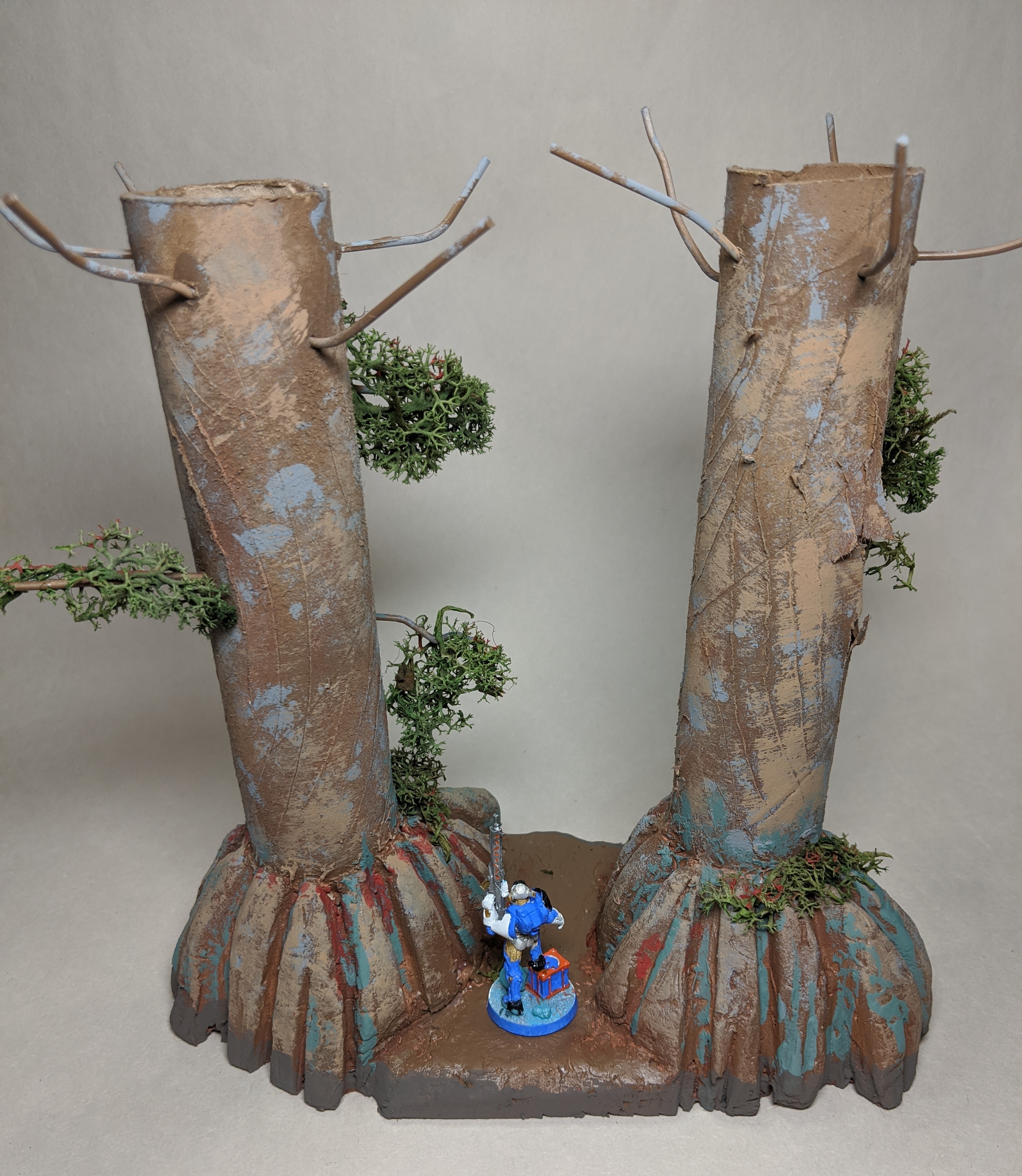
The rest of the set.


Higher resolution images here.

After this side project I built trees.