When Jim Dietz and I discussed the final form that Championship
Formula Racing (CFR) would take, one item in particular stood out on Jim’s wish list - a way to race against the best drivers in history. The vision was to create a Historical Driver system where
different drivers had different personalities, tendencies, and difficulty
levels. It was important that the top
historical drivers in the world would be hard to beat, not just rolling
obstacles.
When Jim Dietz and I discussed the final form that Championship
Formula Racing (CFR) would take, one item in particular stood out on Jim’s wish list - a way to race against the best drivers in history. The vision was to create a Historical Driver system where
different drivers had different personalities, tendencies, and difficulty
levels. It was important that the top
historical drivers in the world would be hard to beat, not just rolling
obstacles.
I wasn’t sure how this would work when I started but this
ended up as one of my favorite parts of CFR. The challenge forced me to consider some core
concepts for creating Automated Opponents.
Below I’ll share what I learned for any other game designers or
tinkerers who might also want to go down this road.
Identify Strategies
My first step in creating an Automated Opponent (AO) was to
figure out what broad strategies I wanted each to pursue. Most hobby games have multiple paths to
victory. Write down those paths and
variations and note which are more popular than others. Don’t
worry if some strategies are not as good as others. If people pursue a strategy, include it on
your list.
Having multiple strategies that an AO can follow allows you
to have multiple AOs that end up doing different things. Some games are just better with a lot of
players so the ability to have multiple diverse AOs can fill in that gap. If only a few AOs would ever be used at the
same time, a variety of AOs will keep each use fresh.
I like an automated system that makes me feel like I am
playing against actual opponents. Real
players have tendencies and goals.
Making popular strategies better represented or more frequent in your AO
design will keep the meta game consistent with or without AOs.
Championship Formula
Racing Example
In CFR broad strategies focus on how quickly to spend your resources. Spend them early for the early lead and try to hold on,
save them for late in the race when everyone else running on bald tires, or spend them evenly throughout the race. I created variations on those three broad
strategies for the AOs in CFR. However, the
popularity of different strategies varies based on the track being used so I
tweaked each AO to pick a different strategy based on the track.
For example, James Hunt will use one of three different strategies: U (more of a mid to late game strategy), Mathy (more of a mid to early game strategy), or Front A (an early game strategy) -- typically in that order. But if the track is particularly suited to an early game strategy he reverses his order of preference. Most of the Historical Drivers in CFR do something similar.

Decision Trees and
Set-Up
Now that we’ve identified the broad strategies that our AOs
will pursue, we need to build a decision tree for each.
For each strategy, figure out what their ideal play would be
and rank all of their other options based on how that will help their
strategy. As a general example, if an AO is pursuing a military
strategy in a game, their first choice for an action on a turn could be to buy the
largest sword, second choice might be to buy more armor, third choice…
etc.
You’ll probably figure out pretty quickly that there are
variations on how an AO could pursue the same basic strategy. Maybe one flavor of military AO buys swords
first, while another makes sure to balance swords with armor.
Don’t forget set-up.
Are there set-up options that might favor one strategy over another that
individual players can choose?
CFR Example
CFR’s basic strategies
lend themselves pretty cleanly to different choices on a given turn. But the reality is that these strategies
exist on a continuum so I ended up creating 10 different strategies along that
continuum:
Front X: uses a ton of resources early and then keeps spending resources until it is in the lead
Front A: pretty much uses resources as much as it can until it runs out
Front B: uses some resources early and then really uses a lot of resources in the middle of the race
Stalking: uses some resources early to stay ahead of most cars, then tries to use resources evenly from then on.
Mathy: will use resources for best effect as soon as possible
Even: attempts to use resources completely the same and evenly throughout the race
U: uses some resources early, saves resources in the middle of the race, then spends the rest at the end
Random: starts out saving its resources, but can switch to spending everything at any time
Back S: spend little at the beginning and then spends more for the rest of the race
Back X: spends little for most of the race before spending everything at the very end
Set-up is also a big part
of CFR. Certain car builds and pole bids
lend themselves to different strategies.
If you want to spend your resources early for an early lead, you might
as well design a car with a high start speed and spend more on the pole bid to start at the front of the grid. Obviously there is a continuum to set-up options as well.

Tactics Change as the
Game Progresses
A diversion into my theory on the three phases of game play,
as illustrated by Ascension. This
structure does not apply to all games but it does apply to a lot of medium to
heavy weight modern board games.
Many games can be split into three
parts: Build the Engine, Run the Engine, Grab Points.
Early in a game, you want to acquire
the tools that you need to pursue your strategy. When I play Ascension, I spend the early game
acquiring cards that let me best acquire more cards or kill off the junk cards I started with. Initially, I don’t care how many points cards are worth, and I don’t care how cool its special power is unless it gets me more cards or
kills more junk.
Once you have your tools, its time
to augment that engine and run it. Twenty points into a sixty point game of Ascension, I switch over to buying cards that
have synergy with what I’ve already acquired.
I’ll pay a little more attention to point values now, but mostly I’m
running my engine. I’m probably not
continuing to acquire more ways to thin my deck.
Near the end of the game, there are
no long term consequences for your actions - it’s all about the short-term
play that helps you win. In the last twenty points of a sixty point Ascension game, I no longer care if the card works with
what else is in my deck, and I stop thinning out junk unless it’s harmless to do
so. It’s all about acquiring maximum points.
Now think about the game for which you are designing your AOs. Are there recognizable phases? How do you measure which phase you are
in. Is it based on the progress of the
game, or a player based metric? Should
your AOs’ decision trees change based on the phase of the game?
CFR Example
CFR strategies are all
about how your tactics change over the course of the race. I developed two tools to trigger those phase
changes. I split each lap into three
sectors. No matter how many laps are
being run, we can figure out if we are in the first, second, or last third of a
race. Next to each corner I noted how
many corners were left in the race.
Corners are where resources are spent, so knowing how many corners
is left compared to how much wear an AO has left is an alternate way to figure
out what part of the race that strategy should be in.
For most of the race my Even strategy will spend resources depending on if the car has more resources then the number of corners remaining. That way, the car spends resources pretty evenly through out the race. On the other hand, the Back S strategy will spend very few resources before the 2nd third of a race.

Obfuscate
If I know what the AO is going to do before the AO does it, that
AO will be a lot less effective. This
will be more or less true depending on the level of player interaction. If there is little player interaction, you
might be able to skip this step. If
there is a lot of player interaction, this step is crucial to creating a
competitive AO.
Randomness is your friend here. Each AO should have at least 2 things it
might do on a given turn, or two ways it might do those things. This way, human opponents are not completely
sure what it will do. Be careful not to resolve that randomness until you absolutely have to -- right
before the AO needs to take an action or figure out if they will take an
action.
But don’t take the randomness too far unless that is the
actual strategy. You want the choices an
AO takes to make sense for its strategy.
The choices may just be slight variations of each other. They probably should not be completely
opposite.
CFR Example
I made sure that each AO in
CFR had a choice between at least two different decision trees during each
phase of its strategy. Often this was
just a reordering of choices or a slight variation. After every corner you roll dice to re-pick a
decision tree for the next corner.

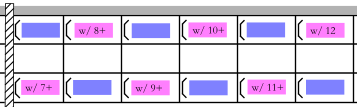
On the right you can see a sample phase from CFR's Front A strategy. Each line is essentially a decision tree giving the car 2 to 4 different choices for how many resources to spend in the next corner. In turn this will determine the car's speed.
The choices at the top direct the car to spend more then the ones further down until the stars indicate that those resources will only get spent if the use is particular efficient use.

Simplify then Cheat
After all of this, your AOs are likely bad at the game and
your decision trees are so complicated that it takes twice as long to take an
AO turn as a real turn.
Go back over your decision trees and simplify them. Then do it again. Pay particular attention to anything you had previously done to obfuscated or randomize AO actions. Does the obfuscation or randomization make it more time consuming to play an AO turn then a human turn?
Now find ways to have your AO "cheat". Cheats can do three things: speed up AO play,
make AOs harder opponents, and give AOs more character.
For instance, consider some mechanics that might take a
while to resolve. Having an AO always
succeed at performing one or more types of actions will speed up play, make them better at the game, and reinforce
their personalities and strategies.
Having an AO "cheat" more or less will also make some AOs better than
others.
CFR Example
Originally, I obfuscated too much. The symbols I used in decision trees had little relationship to the choices they represented. I eventually switching to symbols that better represented the action desired, were easily remembered, and required less translation.
Basic AOs in CFR are
passable, but to create challenging AOs I added a number of "cheats."

Many get bonuses during
set-up. This is my main method for
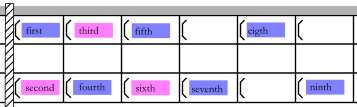
creating some AOs that are harder than others. A normal set-up in CFR uses 2 points to build a car. Stirling Moss' car, shown on the right, uses 4 points including some options (9 wear per lap) that are beyond what is normally available.
All of the AOs in CFR can
auto-pass certain die rolls during the game.
This is mostly a time-saver, but also clearly gives them some
advantages. Normally skill is used as a die roll modifier that helps drivers temporarily improve their car's performance. Historical Drivers use skill to automatically pass those same die rolls.
Finally, many have special
abilities or bonuses that reinforce their character and strategy but also give
them advantages. Stirling Moss can effectively use 3 wear in a corner, which is illegal for anyone else.

Diversify Your AOs
Look at your AOs. Are
there parts of each that can be swapped into another similar AO to create
something new? That’s a great way to
generate a lot more AOs then you thought you had.
For instance, maybe you built 3 AOs that are variations on a
military strategy. Each has a slightly
different set-up and slightly different decision trees. If you separate the set-ups from the decision
trees and randomly recombine them before each game you now have 9 different AOs, where you used to have 3.
Or maybe you find that you can split each AO’s decision
tree into 3 parts. Now you have 3 early
game decision trees, 3 mid game decision trees, and 3 late game decision trees for
each military AO creating even more variety and obfuscation.
CFR Example
In CFR I created 10
different decision trees (strategies) and 24 different set-ups (drivers) that come with in-game "cheats." Each set-up uses one of three
different decision trees.
This went through many changes during testing. Originally, I had 12 generic strategies that were married to particular set-ups. Then I separated set-ups from strategies and was able to reduce both the number of strategies and set-ups but still retained a lot of variety.
Conclusion
The most important part of designing AOs is the same as all
game design: testing. Very few games come with Automated Opponents. So there is a lot of space to practice using
the games already on your shelf.
I’ve started designing AOs for one of my son’s and my old
favorites, Valley of the Mammoths. I’ll
share the results of that project when I’m done. Below is what I ended up with for CFR (development, not final version).